
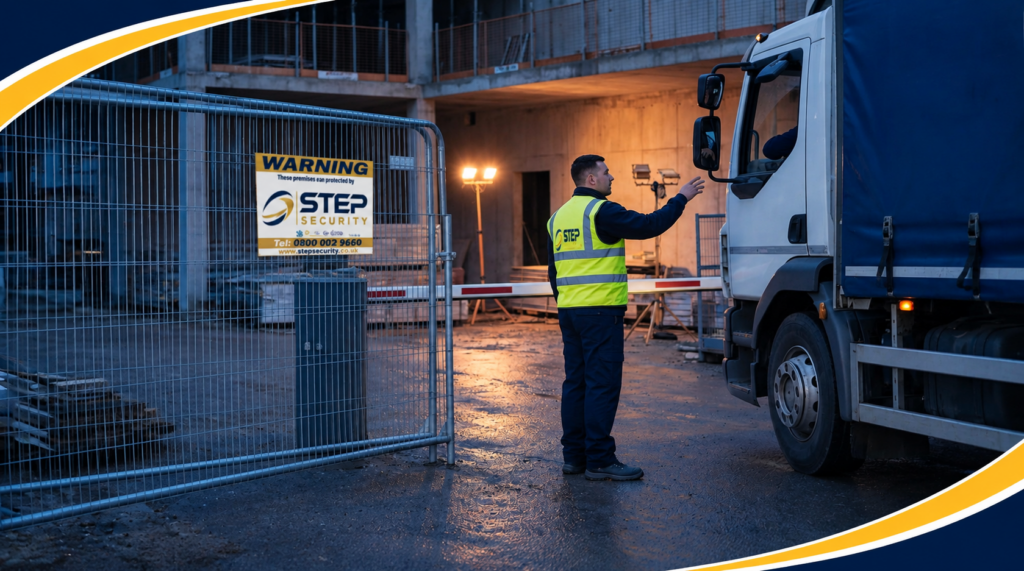
Commercial security guards provide a visible presence on construction sites, in offices and across business premises, with duties tailored to the risks and daily activity at each location.
Choosing the right cover means looking beyond the guard’s post. You also need clear procedures for alarm response, mobile patrols and reporting, so incidents are recorded and action is coordinated. This guide explains what static guarding involves, how to organise security across different premises, and what to expect from alarm response and patrol reports. It also covers how to assess the right service for your site or business.
Key Takeaways
- Match construction-site cover to access points, vulnerable equipment and changing site activity.
- Set clear procedures for office and business-premises access, visitor handling and incident escalation.
- Define a static guard’s post, checks and reporting process so coverage supports daily operations.
- Understand how alarm response and patrol reports help coordinate action and keep a clear record of events.
Construction site security
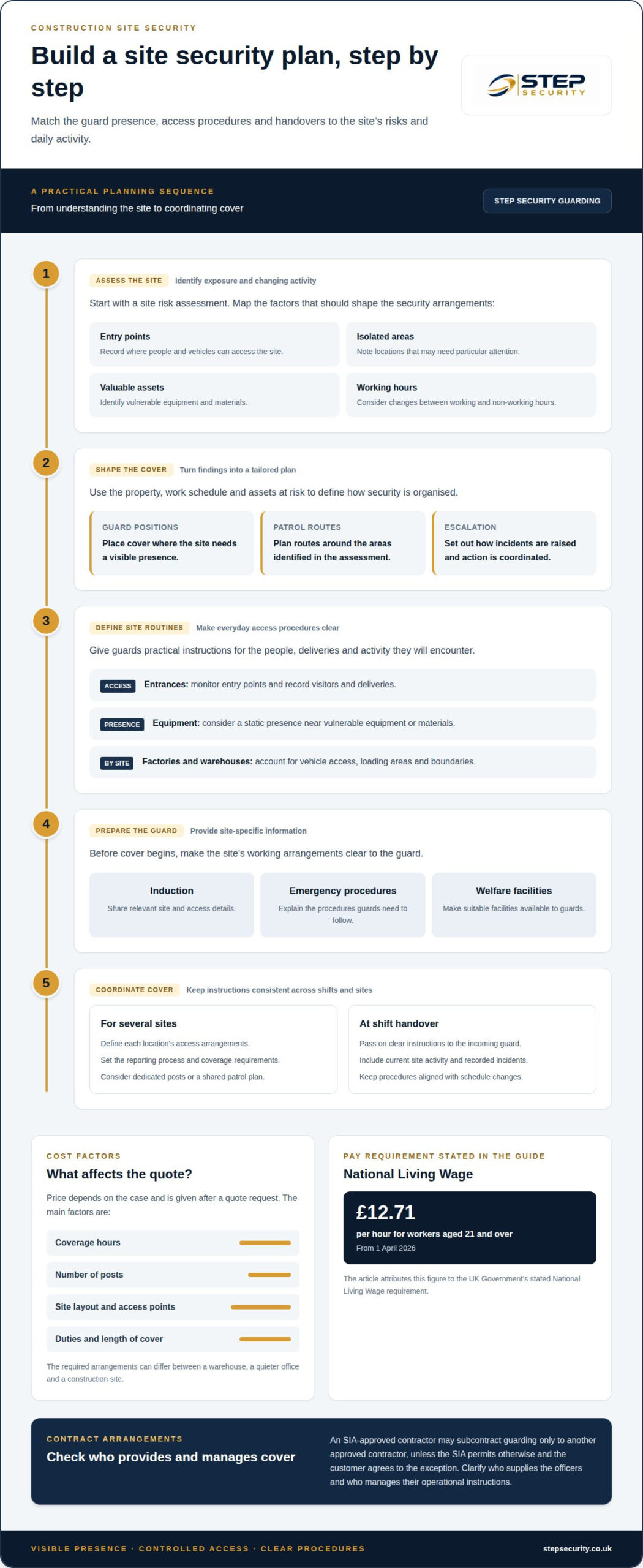
Construction site security combines a visible presence with controlled access and clear site procedures. The right arrangements depend on the property, work schedule and assets at risk.
At a construction site, guards can monitor entrances, record visitors and deliveries, and maintain a static presence near equipment or materials. Factories and warehouses may need closer attention to vehicle access, loading areas and boundaries. Event security serves a different purpose, focusing on temporary gatherings rather than routine site access.
A site risk assessment should identify entry points, isolated areas, valuable equipment and changes between working and non-working hours. Those findings shape a tailored plan, including guard positions, patrol routes and incident escalation. Site managers should also make induction details, emergency procedures and suitable welfare facilities available to guards. According to the UK Government, security providers must pay workers aged 21 and over at least £12.71 an hour from 1 April 2026 as the National Living Wage.
Multi-Site Contracts and Shift Cover
For businesses operating several sites, plans should define each location’s access arrangements, reporting process and coverage requirements. Shift handovers need clear instructions so the incoming guard understands current site activity and any recorded incidents. When assessing cover, consider how changes in work schedules affect staffing and whether each site needs a dedicated post or a shared patrol plan.
In-House and Contracted Security
In-house guards give a business direct control over recruitment, training and day-to-day supervision. Contracted cover places staffing and operational coordination with a security provider. Compare the management time, coverage pattern and consistency each approach requires. Potential gaps include shift changes and guards lacking site-specific information. Written procedures and a thorough induction help address these risks.
Factors Affecting Guard Costs
The cost of hiring guards depends on coverage hours, the number of posts, site layout, access points and the duties required. A warehouse with delivery movements may need different arrangements from a quieter office or construction site. Price depends on the case and is given after a quote request. The main cost factors are the staffing pattern, site requirements and length of cover.
Security services for offices and other business premises
Office security can combine controlled entry, visitor handling and a visible presence. To hire guards in the UK, define the site’s requirements, agree on duties and coverage, then arrange suitable personnel through a compliant security contractor. For help assessing whether security guards for business premises are suitable, consider the site’s operations, vulnerabilities and required duties.
Officer Training and Compliance
Start with contractor approval and officer vetting. Businesses supplying manned guarding in the UK must hold an SIA licence, and working without one is an offence. Officers supplied for guarding or key holding must hold their own SIA licence and be vetted to BS 7858. Security officers undergo five-year employment history verification, and BS 7858:2019 is a named vetting standard.
For office security, set out the tasks before deployment. These might include managing access, directing visitors to reception and escalating incidents through agreed channels. Training should prepare personnel for the duties assigned at the premises. Clarify how officers receive site instructions, reporting lines and updates to access procedures.
An SIA-approved contractor may subcontract only to another approved contractor, unless the SIA permits otherwise and the customer agrees to an exception. This makes the delivery arrangements relevant when assessing a contract. Clarify who supplies the officers and who manages their operational instructions.
Protective Security Officers
Protective security officers can provide a visible, organised presence around people, entrances and sensitive areas. Their duties should follow the premises’ risk assessment and agreed assignment instructions. For example, an office may require controlled visitor access, while a business reception may need officers to direct arrivals and escalate concerns. Define the role’s boundaries so officers know when to observe, report or seek assistance.
For a structured approach to office security planning, set the post, procedures and reporting expectations before cover begins.
Static guarding for commercial premises
Static guarding places a manned officer at an agreed post, such as a reception desk, gatehouse or loading entrance. Duties follow site instructions and may include monitoring access, directing visitors and recording incidents.
Commercial security guard services vary across the UK because each site has distinct operating patterns, layouts and access needs. An office may prioritise reception and visitor access, while a warehouse may need a guard positioned at its vehicle entrance.
Before deployment, define the post and its boundaries. For example, specify which doors the security officers monitor, how deliveries are logged and who receives escalations. A clear brief helps the guard apply consistent entry procedures for staff, visitors and contractors.
At a construction site, a static officer can oversee the main gate and follow the agreed process for checking who enters. At business premises, the post may be near reception, where the guard can direct visitors and notify staff of arrivals. Manned guarding works best when duties are specific to the location.
Static security guards provide a consistent presence at a fixed point, but cannot observe every part of a large premises from one post. Identify areas outside the guard’s view and explain how to report concerns. Assignment instructions should also cover what the officer must do when an incident needs escalation.
Use written instructions to define routine checks, visitor procedures and record-keeping. For example, a guard can log an unexpected delivery, note the time and follow the site’s reporting process. Regular updates help keep instructions aligned with changes to access arrangements or work activity.
A trusted commercial security provider can tailor static cover to the post’s purpose and the premises’ operating schedule. Before cover begins, agree on the location, responsibilities, handover information and reporting format. These steps give the officer a defined role and site management a useful record of activity.
Alarm response and patrol reporting
An alarm signals a potential issue; the response procedure determines what happens next. Business monitored alarm arrangements may include 24/7 monitoring, keyholding and a police or guard response. These functions are distinct: monitoring receives an alert, while keyholding enables an authorised responder to attend and access the property when required under the agreed procedure.
Before service begins, document who receives an alert, who decides the next action and how attendance is recorded. Set out the escalation route for an alarm that cannot be verified remotely. Clear instructions prevent uncertainty between the monitoring team, keyholder and business contact, particularly when staff responsibilities change.
Mobile patrols provide a separate layer of checks. A patrol route can cover entrances, perimeter areas and locations not visible from a fixed post. At a retail property, for example, an officer might check an external door and record an unusual condition for follow-up. Instructions should specify the areas covered, what counts as an exception and who receives an escalation.
A useful patrol report records the time and location of each check, observations, actions taken and outstanding issues. Clear, factual entries help managers understand events without relying on memory. After attending an alarm, a report might note the alert, arrival, checks completed, people contacted and any follow-up required. A consistent format makes records easier to review across shifts or sites.
Before cover begins, agree on the alarm escalation route, keyholding arrangements, patrol scope and reporting format. Explain how officers receive site instructions and updates. Response arrangements should match the property, alarm process and agreed duties. Officers should follow those instructions and record their actions, without assuming authority beyond their assigned role.
For coordinated key holding and alarm response, set clear attendance instructions and reporting expectations for your premises.
Step Security Guarding: Security Guard Service
Step Security Guarding provides security guard services for businesses that need organised cover at commercial premises or construction sites. The right arrangement depends on the site’s layout, access points, operating hours and required guard duties.
Manned guarding provides a static presence, while building site and construction security guards support access procedures on active sites. Clear assignment instructions align the guard’s post, visitor process and reporting route with daily operations.
Turn to Step Security Guarding when you need guarding planned around a specific business or site requirement. Share the location, access arrangements and required duties to help shape a practical service. Contact Step Security Guarding to discuss your security requirements.
Set the next steps for your site
Subcontracting does not have to mean losing oversight. An SIA-approved contractor may subcontract guarding only to another approved contractor, unless the SIA permits otherwise and the customer agrees to the exception. Turn your security priorities into a working brief. Identify the areas that need attention, the duties expected at each post and how incidents should be escalated. This gives commercial security guards a clear operational role and aligns coverage with how your premises function.
Step Security Guarding provides manned guarding, building site security guards and construction security guards. These services support businesses seeking a defined security presence across commercial premises or active building sites. Discuss your site, access arrangements and required duties with Step Security Guarding to plan suitable cover.
Contact Step Security Guarding today to discuss your security requirements. A clear brief is a practical starting point for organised site protection.
Frequently Asked Questions
Do UK security contractors self-deliver static guarding or subcontract?
A company may deliver guarding with its own personnel or subcontract it. An SIA-approved contractor may subcontract only to another approved contractor, unless the SIA permits otherwise and the customer agrees to the exception. For a static post, the contract should make clear which company supplies the officer and manages the assignment. This establishes responsibility for instructions and operational oversight.
What do commercial security guards do in the UK?
Commercial security guards help protect business premises, people and assets through duties tailored to the site. For example, an officer at a distribution depot might manage visitor access, deter trespassing and carry out physical security rounds. In an office, the role could involve monitoring reception and recording arrivals. The agreed assignment defines the post, reporting line and response to incidents.
What types of commercial security guard services are available in the UK?
Services include manned guarding, corporate and concierge security, retail security, construction-site guarding, mobile patrols, and key holding with alarm response. Some businesses also use CCTV monitoring or temporary CCTV towers. The right mix depends on the premises and operational needs. For example, a retailer may need a visible presence on the shop floor, while a business with dispersed buildings may benefit from patrol coverage.
What SIA licence do commercial security guards need in the UK?
Businesses should check that officers assigned to security duties meet the relevant requirements. The role’s duties matter when establishing the appropriate licence requirement, so a job title alone isn’t enough. Businesses can also consider officer vetting: the stated standard for security officers supplied for guarding or key holding is BS 7858. Licence status and vetting are separate checks.
How can a UK business check a security guard’s SIA licence?
Ask to see the officer’s SIA licence and compare its identifying details with the person attending the premises. Check that the licence covers the assigned duties, then keep a record of the check with the contract documents. If officers change, repeat the process for each replacement. This creates a clear compliance record rather than relying on verbal assurance alone.
How do I choose a reputable commercial security company in the UK?
Look for clear evidence of contractor approval, officer licensing, vetting arrangements and defined supervision. A useful contract explains who supplies the guards, how assignment instructions are managed and what reports the business receives. If subcontracting is involved, the approval and customer-agreement conditions should be clear. The company’s proposed duties should also fit the site, rather than relying on a generic deployment plan.