
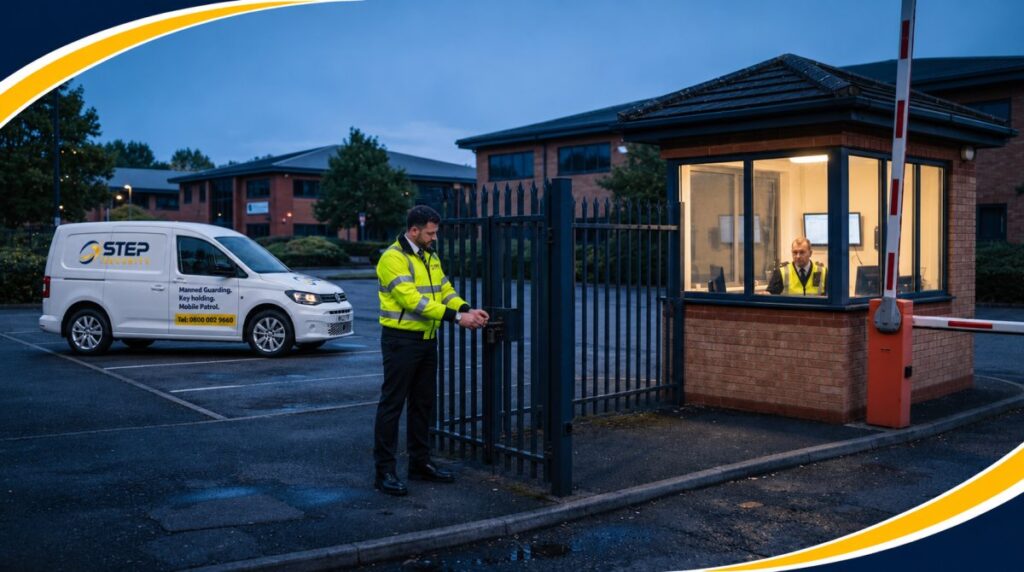
The most visible security presence isn’t always the best fit. The choice of mobile patrols versus static guards depends on your site’s layout, operating hours, risk level and budget. Static guards suit sites that need continuous oversight or controlled access; mobile patrols suit locations where scheduled checks can provide proportionate coverage.
Both options have advantages, but they work differently. A guard stationed at an entrance can manage visitors and respond as activity unfolds. A mobile patrol can check multiple areas or locations without maintaining a constant on-site presence. Combining the two can help when needs vary across the site or operating day.
This guide compares their practical benefits and cost considerations, then explains how access requirements, site activity and risk should shape your decision. You’ll see when either option may be suitable and when a combined approach may be a better fit.
Key Takeaways
- Match the security presence to your site’s risk, layout and operating hours, rather than choosing on cost alone.
- Use mobile patrols to check wider or quieter sites at agreed intervals; they provide intermittent, not continuous, on-site coverage.
- Prioritise static guarding where access control, visitor management or a constant presence is central to daily operations.
- Consider combining both approaches when security needs change across the day, and use a risk assessment to shape the deployment.
What Are the Advantages of Mobile Patrol Security Services?
Mobile patrols suit sites that need visible checks without a guard remaining at one post. The right choice depends on the layout, operating hours, access needs and risk.
Site Layout and Operating Hours
A patrol can check several buildings, entrances or perimeter points across a spread-out industrial estate. A static guard is better placed at a specific gate or reception where visitors need screening. Retail premises may need staffed access during trading, then scheduled checks after closing. The British Standard code of practice for providing mobile security services is BS 7984-3:2020, according to the British Standards Institution.
Continuous and Intermittent Presence
Static guards provide a continuous presence at their assigned post and can monitor activity as it happens. Mobile patrols provide intermittent coverage: officers visit at scheduled or random intervals, inspect the premises and report issues. This can suit vacant buildings or quiet overnight periods, but it does not provide continuous access control between visits. A combined approach can provide different cover during staffed hours and quieter periods.
| Option | Presence | Access and monitoring | Typical fit |
|---|---|---|---|
| Mobile patrol | Intermittent | Checks multiple areas | Large or quiet premises |
| Static guard | Continuous at post | Manages visitors and entry | Busy or access-sensitive sites |
| Combined cover | Varies by period | Matches changing activity | Sites with different day and night needs |
Match the site’s access points, activity and operating hours to the presence required, then consider your budget.
Alarm response: A mobile patrol’s response depends on its route and schedule; an on-site static guard can respond immediately. An illustrative UK comparison gives mobile patrol response times of 8-15 minutes, but that is not a guaranteed response time for every site.
Licensing and screening: According to UK Government, a security guard licence is required to guard premises or property against damage, theft, unauthorised access or disorderly behaviour. BS 7858:2019 is the stated screening benchmark for officers before deployment.
Choosing a provider: Look for a clear deployment plan, documented checks and incident reporting. Make sure the proposed cover fits the site’s access requirements, operating hours and risk assessment.
Security Patrol vs Static Guarding: Which Is Better?
Neither option is better for every site. Mobile patrols suit premises needing checks across several areas; static guarding suits locations where officers must remain available at a fixed point.
Mobile patrol officers inspect perimeters, internal areas, doors and windows for signs of intrusion or damage. They can record hazards, report suspicious activity and follow agreed escalation procedures when an issue arises. Scheduled or random visits provide vacant buildings and closed retail premises with a visible but intermittent security presence.
Static guards are stationed at places such as an office reception, construction gatehouse or retail entrance. Their duties can include checking credentials, managing visitor logs, controlling access and monitoring activity. They can also check deliveries, patrol the site and respond to incidents as they happen. This continuous presence is useful where people, vehicles or valuable assets pass through controlled points.
Industrial estates, business parks, warehouses, car parks and low-occupancy buildings may be suitable for mobile patrols. One patrol can check multiple areas, which can be practical when a fixed post would leave other parts of a large site unattended. Retail sites may also use checks after closing to look for damage or unsecured access points.
Static guarding can be a stronger fit for busy corporate offices, retail stores and construction sites with high-value equipment. An officer can maintain access control and respond at the post. Mobile officers travel between checks, so they cannot continuously supervise an entrance or visitor activity.
Both options involve security officers checking for risks, documenting incidents and following site procedures. The key difference is whether protection depends on a fixed, constant presence or checks across multiple locations. For planned cover across quieter premises, mobile patrol security can be considered alongside the site’s access needs and activity.

Choosing cover based on site access and risk
Base the deployment on access, activity and exposure, rather than assumptions. A risk assessment can consider the site’s location, crime history, asset value, layout, access points, operating hours and existing security systems.
Visible Presence and Site Coverage
A static guard provides a continuous, visible presence at a defined point, such as a construction site entrance. This suits sites with regular visitor access, deliveries or high-value equipment needing oversight. Mobile patrols provide intermittent coverage across separate buildings, boundaries or a large industrial estate. Random checks can make visit times less predictable, but they cannot control an entrance continuously between visits.
The cover required shapes the deployment: staffed hours, number of locations, patrol frequency and access complexity all matter. Intermittent checks may suit a quiet premises, while continuous guarding may be appropriate during a higher-risk period. Businesses can also adjust cover seasonally, using static guards during busy retail trading or active construction phases, then patrols during quieter periods.
Coverage Across Multiple Sites
Mobile patrols can check several properties along a planned route, which can suit a business park with separate buildings or a group of vacant premises. A static guard remains at one location, so continuous presence at additional sites requires separate coverage. Route planning should account for each site’s access points, activity and risk, with checks adjusted as requirements change.
At an industrial site with a staffed gate and a remote storage area, a combined plan could keep access controlled at the gate while scheduling patrol checks around the wider boundary. If out-of-hours alarms need a response, key holding can be part of the arrangement. The right balance depends on which areas need continuous supervision and which need periodic checks.
Use the risk assessment to match each site’s operating hours, visitor flow and asset exposure to the required presence. Review the plan when access patterns or seasonal activity change.
Comparison of static guards and mobile patrols
The practical difference is continuity. Static guarding keeps an officer at a designated post, while mobile patrols move between checks. This affects coverage, incident response and how a security plan can adapt across buildings.
| Criterion | Static guarding | Mobile patrols |
|---|---|---|
| Presence | Constant at the assigned post | Intermittent across the patrol route |
| Response | Immediate at the staffed location | Depends on the officer’s location and schedule |
| Coverage | Focused on one site or access point | Can extend across multiple locations |
| Best suited to | Busy entrances and active construction sites | Wider premises needing periodic checks |
At an office with regular visitors, a static guard can verify entry and address incidents as they occur. At a vacant building, patrol visits can check for signs of intrusion without a constant post. Each approach has limits: patrol officers may be elsewhere between visits, while a static guard’s attention is centred on their assigned location.
Construction sites show why the choice can change with operating periods. During deliveries or active work, a stationed officer can oversee access and movement. Once activity ends, scheduled or random patrols can check boundaries and buildings. A layered plan can align cover with changing exposure instead of using the same deployment throughout.
Mobile patrols can provide broader coverage at a lower cost than continuous static guarding, but cost is only one criterion. Consider which incidents require immediate intervention, whether visitors need supervision, and whether checks must cover several sites. The stronger option is the one that closes the site’s main operational gaps.
For a site with both controlled access and areas needing periodic checks, set the required coverage by location and operating period. Discuss a security deployment plan that reflects those priorities.
Step Security Guarding: Security Guard Service
Step Security Guarding can help businesses align security cover with site access, activity and risk. Its services include Mobile Patrols and Manned Guarding, as well as Building Site Security Guards for construction environments.
Choose Mobile Patrols when a site needs scheduled checks across wider areas or during quieter periods. Manned Guarding suits locations that need an officer at a fixed post, such as an active entrance or construction site. Where conditions change during operating hours, cover can be planned around those different requirements.
Share your site layout, access points, operating hours and main security concerns to support a practical deployment plan. Contact Step Security Guarding to discuss security cover for your site.
Keep your security plan aligned with changing site needs
Security requirements can shift as a site changes. A new tenant, altered delivery pattern or expanded storage area may create different access and oversight needs. Review security cover as part of operational planning so it stays aligned with how the premises are used.
A decision on mobile patrols versus static guards should account for changes, not just the site’s current layout. If continuous access control becomes more important, the deployment may need to change. If activity falls, scheduled checks may be more appropriate. Construction Security Guards can support construction environments that need site-specific guarding.
Step Security Guarding can help you consider suitable cover for your premises and operating requirements. Contact Step Security Guarding to discuss the next step for your site.
Frequently Asked Questions
Which Option Is Better?
Neither option is universally better; the right choice depends on what your site needs security staff to do. For example, a distribution building with controlled vehicle access may need a guard at its entrance, while several quiet, separate buildings may benefit from patrol checks. Prioritise the site’s main risks and the response required when deciding between mobile patrols and static guards.
Can you combine both?
Yes. Combining both can match cover to different operating periods or areas. For example, a construction site could use a guard to manage deliveries during working hours, then scheduled patrols to check the perimeter after activity stops. This can also suit a business park where one entrance needs oversight but other buildings need periodic checks. The deployment should define each role and handover arrangements.
How to Choose the Right Security Solution?
Start with a site-specific risk assessment, then match the identified risks to the security tasks required. A warehouse with valuable stock and frequent vehicle movements has different needs from a vacant office with limited access. Consider the premises’ layout, entry points, operating schedule, visitor activity and existing security measures. These details help determine whether a fixed post, patrol checks or combined cover is appropriate.
Is a mobile patrol as effective as having a guard on site?
Not for every task: a patrol cannot provide continuous supervision at an entrance between visits. It can suit sites where periodic checks of boundaries and access points meet the operational need. An on-site guard is better placed to manage visitors or respond immediately at their post. Suitability depends on the risk, the area requiring attention and the response needed.
What Is the Difference Between Static and Mobile Security?
Static security assigns an officer to a fixed location; mobile security sends officers between premises or checkpoints. At a staffed reception, a static officer can oversee entry and visitor activity. A mobile officer can travel between buildings to conduct scheduled or random checks. The key difference is the officer’s position and whether the priority is continuous oversight or broader, intermittent coverage.
What does a patrol officer check on each visit?
A patrol officer follows the agreed site requirements, which can include checking gates, doors, fencing and other access points. For example, they may look for damage, forced entry or an unsecured boundary. If they find an issue, they follow the agreed reporting and escalation procedures. Checks can be scheduled or random, according to the patrol arrangement.