
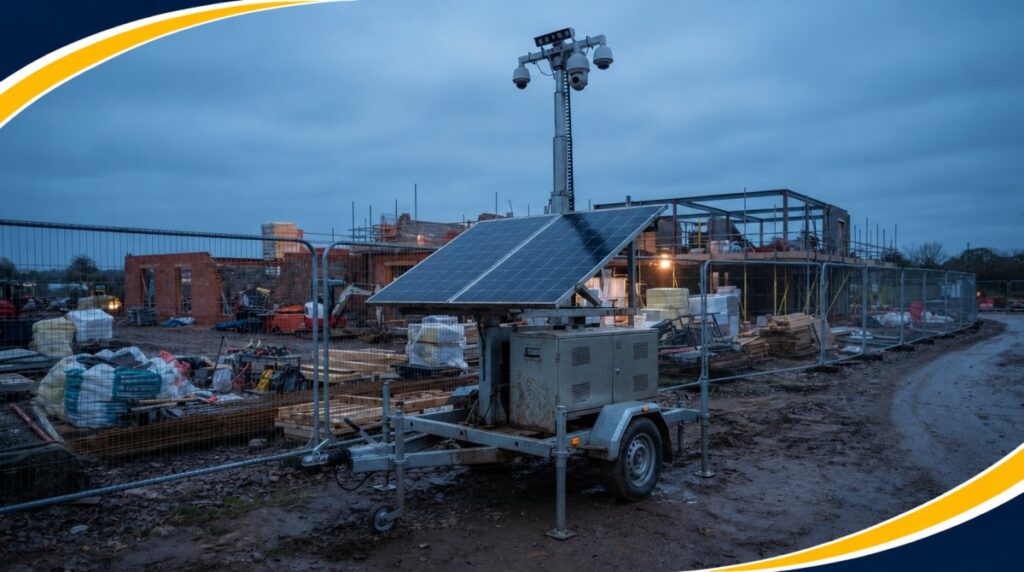
A solar-powered CCTV tower can monitor a temporary UK site without a mains connection. Solar panels charge onboard batteries that power the cameras and communications equipment. This makes solar-powered CCTV tower hire in the UK useful where connecting to the electricity supply would add work or delay deployment.
Reliable coverage depends on choosing a suitable position. Entry points, valuable assets, sightlines and potential shade all affect placement, while battery capacity matters during overcast spells and shorter winter days. A mobile tower can also be repositioned as a construction site changes.
This guide explains how to plan deployment, from assessing the site and choosing camera positions to setting up equipment and maintaining coverage. It also covers how solar power differs from a mains-connected system, how weather affects operation, and how CCTV monitoring or on-site security can fit into a wider site-security plan.
Key Takeaways
- Understand how solar-powered towers differ from generators, fixed CCTV and manned guarding when planning temporary site security.
- See how remote monitoring can support incident assessment and response, rather than simply recording activity.
- Learn why winter daylight, battery reserve and panel condition matter when maintaining coverage through changeable UK weather.
- Identify the deployment factors that shape camera coverage, and when CCTV Towers or security guards may support your site plan.
What Makes a Solar CCTV Tower Different?
A solar CCTV tower combines cameras, photovoltaic panels and an onboard battery in one mobile unit. On construction sites without convenient mains infrastructure, it can provide surveillance without trenching for a connection or arranging an electrician. Solar-powered CCTV tower hire in the UK can suit temporary sites where mains access would add work or delay deployment.
Hire and Running Costs
Hire and running costs cover the tower’s deployment and operation, plus any separately agreed support. Before arranging solar-powered CCTV tower hire in the UK, ensure the quote sets out whether delivery, installation, monitoring and maintenance are included or charged separately. Hire periods can range from several weeks to months, depending on the contract and site needs.
Solar operation avoids generator fuel, while the battery stores energy for use after daylight. Fixed CCTV requires installation, and a temporary mains connection can involve trenching, an electrician and an ongoing electricity account. Guards involve wages, supervision and cover. The overall cost depends on site needs and hire duration, with the amount provided after a quote request.
For a useful quote, outline the site location, expected hire period, key entrances, asset areas, desired camera views and mains availability. These details help define how a CCTV tower can be deployed and whether additional support, such as remote monitoring or on-site guarding, is needed.
Coverage and Camera Features
Coverage describes the area a tower’s cameras can monitor from their selected position. Solar CCTV towers can combine high-definition imaging, infrared night vision and remote access. Some systems offer 360-degree coverage, but the usable view depends on camera configuration, placement and obstructions around the site.
For example, a tower near a construction site entrance can monitor vehicle and pedestrian activity, while an asset area may require a different camera angle. Coverage varies with camera positioning and site layout, and infrared night vision can support imaging in darkness. Include priority areas and access points in your enquiry.
Remote monitoring and incident response
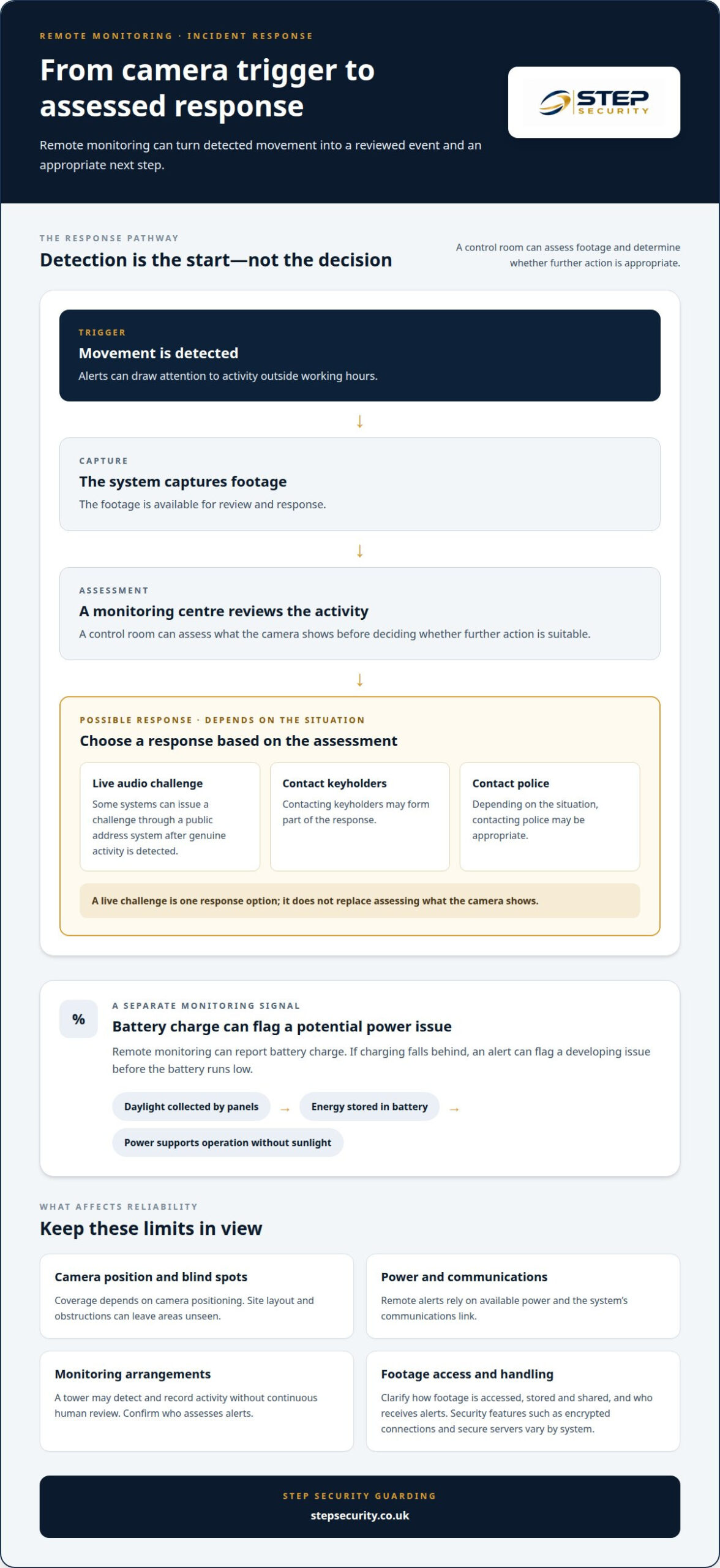
Remote CCTV monitoring connects a tower to a monitoring centre, where activity can be assessed. When movement triggers a camera, the system captures footage for review and response. This creates a route from detection to assessment, rather than relying only on recordings viewed afterwards.
Alerts can draw attention to movement outside working hours. A control room may then assess the camera footage and determine whether further action is appropriate. Some systems can issue a live audio challenge through a public address system after genuine activity is detected. Depending on the situation, the response may include contacting keyholders or police. A live challenge is one response option, not a substitute for assessing what the camera shows.
Remote monitoring can also report a tower’s battery charge level. An alert can flag a potential power issue if charging falls behind, before the battery runs low. Solar panels collect daylight, while stored energy supports operation when sunlight is unavailable. Battery capacity, charging conditions and communications links all affect how consistently a tower can send footage and alerts.
Solar-powered towers have practical limits: coverage depends on camera positioning, and remote alerts rely on the system’s communications link and available power. Security risks can include blind spots and unauthorised access to footage or monitoring accounts. Clear access controls and careful handling of recorded material help address these risks.
Data security matters because remote monitoring transfers camera information beyond the construction site. Some systems describe encrypted connections and secure servers, but these features vary. Clarify how footage is accessed, stored and shared, and who receives alerts. Monitoring arrangements also differ: a tower may detect and record activity without continuous human review. Confirming the distinction helps align the system’s response with the site’s security needs.
British weather and winter performance
Solar performance changes with the seasons, so a tower sized around summer daylight may have less battery reserve in December and January. Shorter days leave less time for panels to recharge the battery. On a construction site needing overnight camera coverage, the system needs enough stored capacity to keep operating when daylight is limited.
Cloud cover reduces charging, but does not stop it altogether. Photovoltaic panels can capture diffused daylight, while battery storage supports operation during overcast conditions. When planning, consider whether the battery reserve can support the required operation through several consecutive overcast days. This is especially relevant on UK sites, where changing weather can reduce incoming solar energy.
Cold conditions matter too. Extreme cold can reduce how much charge a battery holds, leaving less energy available for the camera and detection system. Winter performance therefore depends on more than the panel’s ability to collect daylight. Battery capacity and expected operating conditions both shape the available reserve.
Site position and panel condition affect how much energy reaches the battery. Trees, nearby buildings or the tower’s own mast can cast shade, so assess potential obstructions before placing the unit. Keep panels clean and clear of debris to support charging. Remote battery monitoring can flag a developing power issue before the battery runs down.
For a winter assessment, consider the deployment season, available daylight, shading and battery reserve together. A system selected for summer may need closer attention during December and January. If the site’s security plan depends on a particular camera view or motion-triggered response, the tower’s power capacity must support that operation through darker, colder spells.
Solar-powered CCTV tower hire and deployment
Deployment starts by matching the tower’s position to site priorities. On a construction site, map entry points, valuable assets and the camera views needed for surveillance. Choose a clear, stable position that gives the panels access to daylight. Assess trees, buildings and the mast itself for potential shade before placing the unit.
In the UK, panels are commonly oriented south-facing with a tilt of about 35-40 degrees. A camera mounting height of 3 to 4 metres is suggested for most sites. These are planning guidelines, not a substitute for adapting the position to the ground, sightlines and security objectives. Remote locations without mains power can use a self-contained tower, while mobile units can be repositioned as site layouts change.
Check that the site has a stable position for the tower, delivery access and enough clear space for the intended camera views. Obtain approval from the site authority or landowner before deployment, and plan camera coverage to respect neighbouring areas and privacy. CCTV footage handling should also form part of the site’s arrangements under applicable UK data protection requirements.
A practical hire process starts with the project’s requirements. Identify the areas needing surveillance and any access constraints, then assess shade, ground conditions, camera angles and the available communications link. Position the tower and confirm that its cameras cover priority areas. As construction progresses, the mobile unit can be relocated to reflect new entrances, changing asset locations or updated site boundaries.
Winter deployment also calls for attention to daylight and battery capacity, particularly where the tower must operate through darker periods. A site plan that records priority views, obstructions and relocation needs helps keep coverage aligned with changing work phases. For support with CCTV tower deployment, set out the site layout and security priorities.
Step Security Guarding: CCTV Towers
Step Security Guarding provides CCTV Towers for sites that need visible surveillance without a permanent mains connection. They can support construction projects where access points, equipment and changing site boundaries require planned coverage. If camera surveillance alone does not meet the site’s needs, Building Site Security Guards or Construction Security Guards can provide an on-site security presence.
The right combination depends on the site layout and level of oversight required. A tower can help monitor key areas, while guards address security needs requiring a physical presence. This approach can suit early construction stages, changing work phases or other periods when site security arrangements need to adapt.
For a site-specific discussion, contact Step Security Guarding.
Set the next stage of site security
Use the site’s changing priorities to guide the next security decision. A clear deployment brief can identify areas needing attention, how access changes during each work phase, and whether camera coverage alone meets operational needs. This gives solar-powered CCTV tower hire in the UK a defined role in the wider site plan, rather than treating the equipment as a standalone answer.
Where a physical presence is also required, Step Security offers Manned Guarding, Building Site Security Guards and Construction Security Guards. These services can form part of a security plan alongside CCTV Towers, depending on the site’s requirements.
Bring the project layout, access arrangements and security priorities together before deployment. This gives the planning discussion a practical focus and helps align coverage with site operations as they develop.
Contact Step Security Guarding to discuss your site security requirements and plan the next step with confidence.
Frequently Asked Questions
Are they easy to move?
Yes. A mobile CCTV tower can be repositioned as a site changes, provided there is suitable access and a stable new position. For example, a construction project might relocate surveillance as work shifts from perimeter preparation to a new building area. After each move, reassess camera views, nearby obstructions and panel exposure to ensure the new position supports the intended coverage.
Can they run in winter?
Yes. Solar CCTV towers can operate in winter, but shorter daylight in December and January reduces charging time. Extreme cold can also reduce the charge a battery holds. For a site relying on overnight recording, consider seasonal power requirements and panel exposure when planning deployment. A system sized around summer conditions may have less operating reserve during winter weather.
What is a solar-powered CCTV tower and how does it work?
A solar CCTV tower is a mobile surveillance unit that uses solar panels and stored battery power to operate its camera and communications equipment. The panel collects daylight, and the battery supplies energy when generation drops, including overnight. For example, a temporary site without a practical electricity connection can use a tower to monitor a chosen access area without installing fixed CCTV infrastructure.
How much does it cost to hire a solar CCTV tower in the UK?
Hire costs depend on site requirements, so each project needs a tailored quote rather than a single price. The hire period, equipment, deployment needs and any required remote monitoring or additional support help define the scope. For a useful enquiry, describe the site layout, intended coverage, access arrangements and expected duration.
How long can a solar CCTV tower operate without sunlight, and what happens in winter?
Operation without direct sunlight depends on battery capacity, energy demand and recent charging conditions. Battery storage can support operation through overcast periods, but shorter winter days can reduce the reserve available for subsequent periods. A tower running camera detection and communications, for example, uses power for both functions. Plan deployment around the required operating pattern and seasonal conditions.
How quickly can a CCTV tower be delivered and installed across the UK?
Delivery and setup timing depends on the tower’s location, transport access, site readiness and deployment requirements. A clear delivery route and agreed position can help prevent delays caused by restricted access or an unprepared area. Include the site address, access instructions, preferred placement and any delivery constraints in your enquiry so the arrangements can be planned appropriately.