
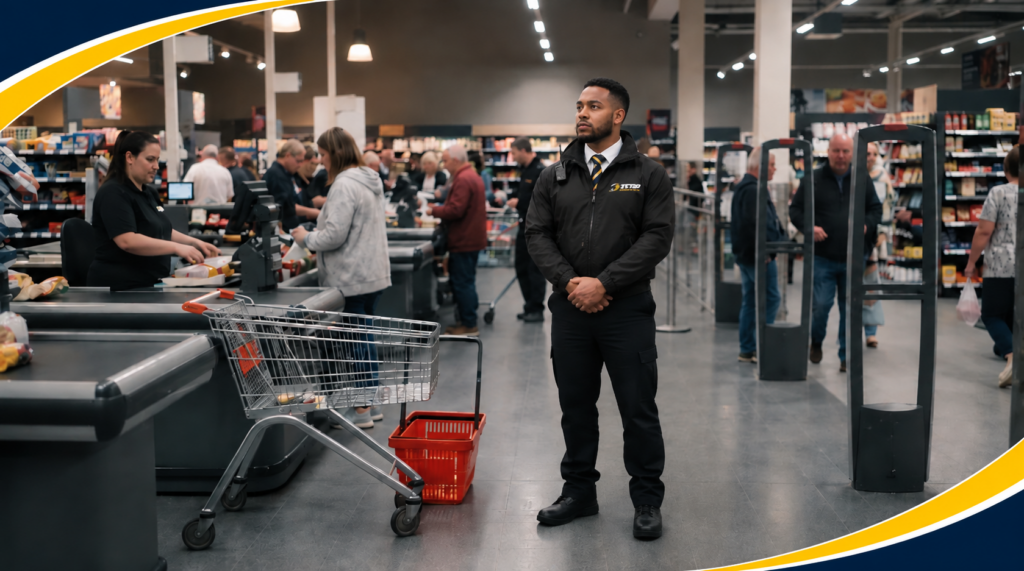
Retail security involves more than maintaining a visible presence. When choosing a trusted commercial security provider, assess how its officers and monitoring support your premises, how personnel are vetted and licensed, and whether its approach to loss prevention fits your retail environment.
It’s reasonable to expect clear procedures and a service shaped around your premises, people and operating needs. Retail teams also need security that supports day-to-day operations while helping identify and manage risks, rather than focusing on incidents alone.
This guide explains how to assess security monitoring and emergency response, understand relevant credentials, and identify practical ways retail security and loss prevention can help. Use these points to compare the support your business needs.
Key Takeaways
- Assess monitoring and emergency response by how clearly procedures support incident handling and operational continuity.
- Understand how staff licensing and security certification relate to accountability when comparing providers.
- Look beyond accreditation labels: establish what NSI Gold and BAFE cover and how each applies to the service you need.
- For retail premises, consider how visible security and loss prevention can support staff, customers and day-to-day operations.
Monitoring options and emergency response
According to the Office for National Statistics, business property robberies in England and Wales rose by 50% to 15,520 offences in the year ending March 2025. Monitoring should therefore connect detection to a clear response, not simply record events. Commercial security systems can combine CCTV, intruder alarms and access control systems so staff can identify activity, manage entry and follow an incident procedure.
Decide what needs monitoring and when. Live CCTV monitoring can support observation of entrances, loading areas or a retail floor, while recorded footage can help reconstruct an incident afterwards. Alarm monitoring can route an alert to designated contacts or an Alarm Receiving Centre. For centres, BS EN 50518 is the standard identified for their construction and operation. Set out who receives alerts, who makes decisions and how incidents are logged.
A commercial security service level agreement should define the monitored systems, coverage hours, alert escalation route, responsibilities, reporting and maintenance arrangements. It should also explain how faults are reported and how changes to contacts or site access are recorded. These details make response expectations clear to both parties.
Remote CCTV monitoring provides visual oversight of a site, while on-site officers can manage access, patrol and respond in person. These are different functions, so assess them against your risks rather than treating one as a replacement for the other. For retail premises, consider which areas need camera coverage and where a visible officer or loss prevention presence would better support staff and customers.
The cost of commercial security depends on the type of cover, operating hours, site layout and duties required. A staffed retail entrance, for example, has different requirements from mobile patrols or remote CCTV monitoring. Set out the premises, key risks and expected duties when requesting a quote so the proposed scope reflects your needs.
Insurance discounts and security certification
Certification, licensing and insurance evidence address different parts of commercial security. Assess each against the specific duties and systems involved.
Licensing and certifications
The Private Security Industry Act 2001 establishes the statutory framework for the Security Industry Authority and its licensing of specified security roles, according to The National Archives (legislation.gov.uk). Sia License, Safecontractors, consturctionline and CHAS are names buyers may encounter, but they are not interchangeable. There is no single accreditation that applies to every commercial security service; match credentials to the work being contracted.
UK security services are shaped by role-specific SIA licensing and, for CCTV, data protection requirements. The ICO’s CCTV guidance covers matters such as signage, retention and access rights; the Data Protection Act and GDPR are relevant considerations. Confirm that procedures reflect the cameras’ purpose, the areas covered and who can access recordings.
Provider insurance, vetting and training
Review insurance documents for the activities and premises covered, and check that named duties match the contract. A retail assignment, for example, may involve different operational risks from a building site. Ask how staff vetting is recorded and how training prepares personnel for access procedures, incident reporting and escalation. Clear records make accountability easier to assess.
A structured review links credentials to the actual post, site and equipment. For practical cover, explore commercial security support tailored to your operational requirements.
This keeps credentials in proportion and helps distinguish evidence relevant to the service from claims that do not address the work under review.
Which UK commercial security companies are reputable and independently reviewed?
Reputation is best judged through several types of evidence, not one rating or badge. Consider providers serving local businesses for at least a decade, alongside current independent reviews and credentials relevant to the work. Longevity can indicate experience, but it doesn’t by itself show how a company handles your specific site or contract.
Read reviews for detail and consistency. Look for descriptions of the service, location or operational issue, rather than relying on brief praise without context. Check when reviews were posted, whether feedback covers different periods, and how the company responds to concerns. A considered response can show how issues are handled, but it cannot prove every account is representative.
Check that review profiles refer to the same business you are assessing, and compare the company name and service description across its published information. Look for feedback relevant to your needs: retail security experience, for example, may not indicate how a provider handles construction site security. Treat star ratings as a starting point, not a complete assessment.
Industry membership offers another context, but it is not the same as an independent customer review or a guarantee of service quality. The British Security Industry Association represents over 520 member companies, and its members provide more than 70% of UK security products and services by turnover. Consider membership alongside the company’s relevant experience, credentials and review history.
Build a short evidence record before making a decision:
- Review quality: Look for specific, relevant examples across different dates.
- Response practice: Note whether replies address concerns clearly and professionally.
- Local experience: Consider a record of serving local businesses for at least a decade.
- Service fit: Compare reviews and credentials with the actual site and duties.
Step Security Guarding
22 Years Industry experience, Step Security provides UK businesses with practical guarding and monitoring services. Consider its support when your assessment points to a need for on-site personnel, access management or site-focused protection. Manned Guarding supports commercial premises, while Retail Security and Loss Prevention Officers address retail security needs. Site Security and Construction Security are designed for construction and commercial sites.
Describe your premises, operating requirements and main security concerns. This gives the team a clear basis for discussing suitable cover and how it can fit your working environment. Request a free, no-obligation quote to take the next step.
Contact Step Security Guarding to discuss your commercial security requirements.
Set your security plan in motion
Turn your assessment into a practical brief. Define the areas to protect, the duties officers must carry out and how security should fit your daily operations. This gives the discussion a clear starting point based on your premises and priorities.
A trusted commercial security provider should be able to discuss your requirements in practical terms. Step Security provides Manned Guarding, Retail Security, Site Security and Construction Security for businesses seeking on-site protection. The right arrangement depends on the premises and duties involved, so set out your priorities before agreeing the scope.
Use your assessment to identify the support that matters most, whether that means a visible presence in a retail environment or security for a building project. A focused conversation can clarify how guarding could fit your operational needs and responsibilities.
Contact Step Security Guarding to discuss your commercial security requirements and take the next step with confidence.
Frequently Asked Questions
What to Look for in a Reliable Commercial Security Provider?
Look for a clear match between the provider’s services and your site’s operating needs. For example, a warehouse with frequent deliveries may need defined visitor procedures and controlled vehicle access. Review staff licensing, insurance, incident reporting and escalation arrangements. Ask how changes, such as new entrances or revised opening hours, will be reflected in instructions and day-to-day security operations.
Can commercial security systems include monitoring as well as on-site protection?
Yes. Remote CCTV monitoring can be combined with on-site security personnel. The roles are different: CCTV provides visual oversight, while officers can manage access, patrol areas and respond in person. For example, monitoring may identify activity near a loading bay, while on-site personnel follow the agreed response procedure. Define responsibilities for alerts, response and incident records.
What makes a commercial security provider trustworthy in the UK?
A trusted commercial security provider gives clear, consistent information about its scope, personnel and procedures. Look for evidence that matches your specific requirements, such as relevant reviews and documented arrangements for handling incidents. A practical test is whether the proposed plan explains who manages access, records concerns and communicates operational changes, rather than relying on broad claims about protection.
Is the security provider licensed by the Security Industry Authority (SIA)?
Step Security Guarding security officers hold valid SIA licences and are vetted and trained before deployment. Licensing applies to specified security roles, so the relevant point is whether the individual carrying out licensable duties holds the appropriate licence. The Private Security Industry Act 2001 provides the statutory framework for SIA licensing of those roles.
How much do commercial security services cost in the UK per hour or per site?
Commercial security costs depend on the duties, hours, site layout and level of cover required, so there is no single rate for every contract. Step Security provides a tailored, no-obligation quote rather than publishing hourly or per-site prices. To help define the scope, describe the premises, required duties, operating hours and any access or reporting procedures.
What types of commercial security services are available, including guards, CCTV and alarm monitoring?
Commercial security options include Manned Guarding, Mobile Patrols, Access Control, CCTV Monitoring, Key Holding & Alarm Response, Retail Security, Loss Prevention Officers, Site Security, Construction Security, Corporate Security, Concierge Security and Event Security. Each addresses different operational needs: a staffed entrance, for example, differs from remote CCTV monitoring or alarm response. Describe your priorities to discuss a suitable combination of services.