
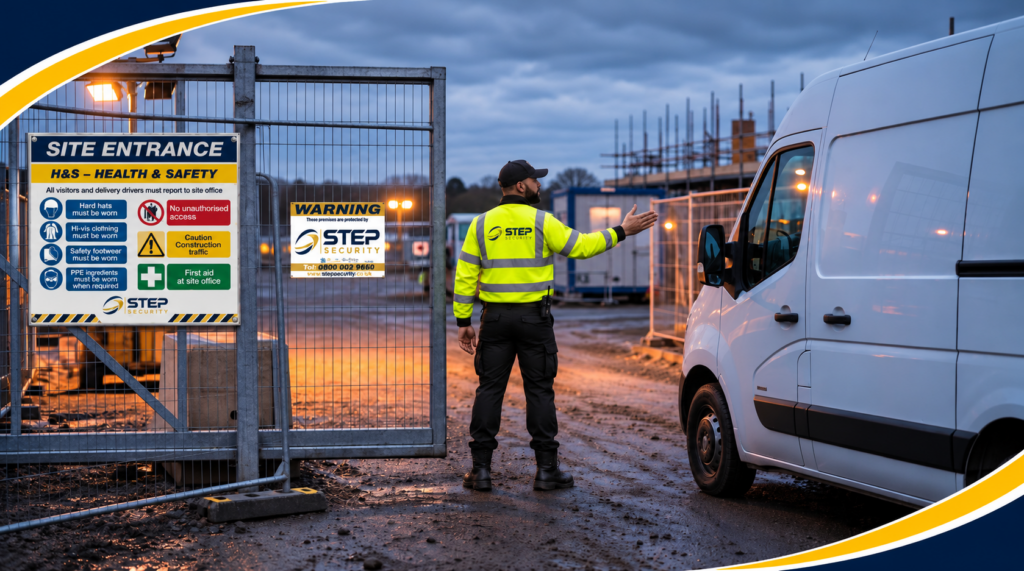
A strong site security plan may not need a guard at every gate. Use an on-site presence where access control, visible deterrence or an immediate human response matters; choose mobile patrols for scheduled checks across a wider area, and CCTV for remote monitoring. Manned guarding services can work alongside these measures when a site needs layered protection.
Each option meets a different security need, so the right choice depends on the site, its activity and the risks to manage. A construction site with changing access points, a busy retail environment and a commercial building with monitored entrances may each need a different arrangement.
This guide compares guarding with mobile patrols and CCTV, explains when combining measures makes sense, and outlines which sites may benefit from guards. It also covers what to consider when planning coverage, so you can match security arrangements to the way your site operates.
Key Takeaways
- Match on-site guarding, mobile patrols and CCTV to the site’s access points, activity and need for an immediate response.
- The Home Office’s 2023 Commercial Victimisation Survey estimated that 26% of business premises in England and Wales experienced crime in the previous 12 months.
- Combine guards with monitoring, alarms and access control when each measure has a clear role in the site’s security plan.
- Consider how construction, commercial and retail sites operate to identify where a visible on-site presence can support security.
Manned guarding, mobile patrols or CCTV?
Choose according to the site’s layout, access needs and required response. A guard provides an on-site presence, while patrols and CCTV meet different monitoring needs.
Guarding Compared with Electronic Security
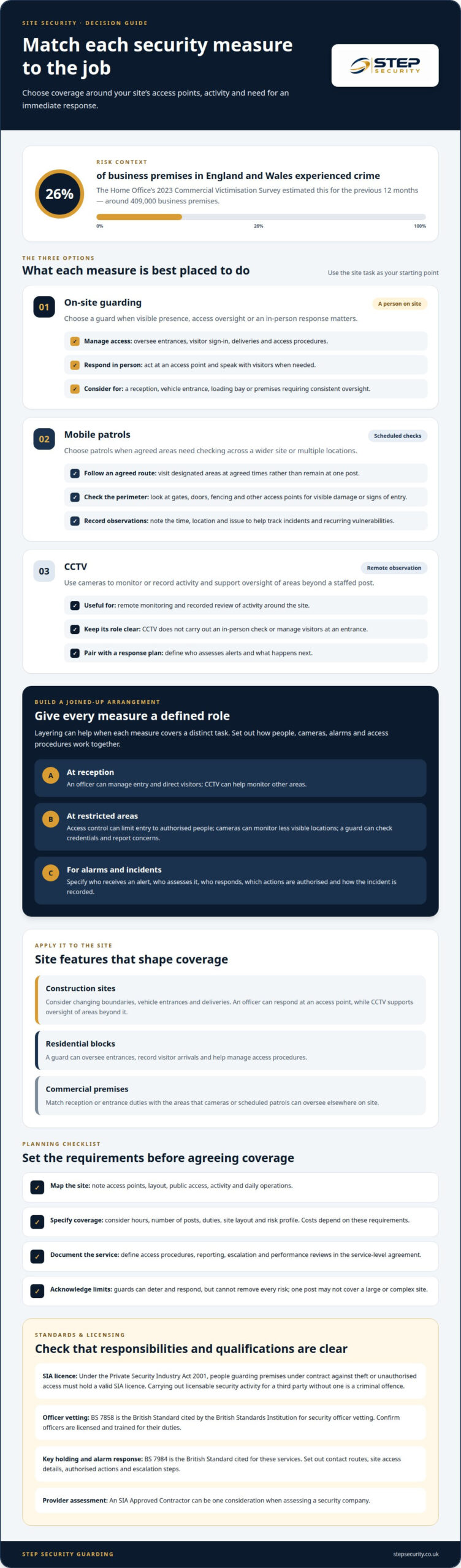
CCTV records or monitors activity, while mobile patrols visit designated areas at agreed times. Neither provides the same continuous, visible on-site presence as a guard who can manage visitors and respond in person. The Home Office’s 2023 Commercial Victimisation Survey estimated that 26% of business premises in England and Wales were victims of crime in the previous 12 months, around 409,000 business premises. Consider where incidents could occur and how quickly someone needs to act.
Security for Residential and Construction Sites
At a residential block, a guard can oversee entrances, record visitor arrivals and help manage access procedures. Construction sites may need attention to changing boundaries, vehicle entrances and deliveries. An officer can respond to activity at an access point, while CCTV supports oversight of areas beyond it. Let the site’s layout, public access and daily operations shape post duties and coverage.
Hiring Costs, Risks and Limitations
Costs depend on the hours and coverage required, number of posts, site layout, duties and risk profile. Define these requirements before agreeing a service-level agreement, including access procedures, reporting, escalation and performance reviews. Guards can deter and respond, but cannot remove every risk; one post may not cover a large or complex site. Clear duties help address that limitation.
Under the Private Security Industry Act 2001, people guarding premises under contract against theft or unauthorised access must hold a valid SIA licence; carrying out licensable security activity for a third party without one is a criminal offence. Security officer vetting is associated with BS 7858, the British Standard cited by the British Standards Institution. Confirm that officers are licensed and trained for their duties, and define supervision and incident reporting in the agreement. An SIA Approved Contractor can be one consideration when assessing a security company.
Manned guarding compared with patrols and CCTV
Choose an arrangement by matching each security measure to a site task. A fixed post, scheduled patrol and camera monitoring each provide a different type of oversight.
Static and Mobile Guarding
Static guarding places an officer at a defined point, such as a reception desk, vehicle entrance or loading bay. It suits premises where visitors need direction or access requires consistent oversight. Mobile patrols move between locations, checking agreed areas rather than remaining at one post. Consider whether you need a continuous presence at one access point or coverage across separate buildings and boundaries.
Perimeter Checks
A mobile patrol can follow an agreed route around a premises, checking gates, doors, fencing and other access points for visible damage or signs of entry. The patrol record can note the time, location and issue observed, helping the site team track incidents and recurring vulnerabilities. Plan the route around the property’s layout, including quieter entrances that may receive less routine attention.
Everyday Guarding and Patrols
Duties depend on the site. A static officer can manage visitor sign-in and direct deliveries, while a patrol can check shared areas and report unsecured doors. CCTV supports remote observation and recorded review, but does not carry out an in-person check. Decide which tasks need an officer on site, which can be covered by scheduled visits, and where cameras add useful oversight.
Key holding and alarm response can link an alarm activation to an agreed response process. BS 7984 is the British Standard cited for key holding and alarm response. Set out who receives an alert, how access is managed and how incidents are recorded. For premises needing scheduled external checks, mobile patrols can form part of the security arrangement alongside static guarding or CCTV.
Combining guarding with CCTV, alarms and access control
In the UK, manned guarding can include a staffed post, access control, reception and visitor management, CCTV monitoring, and agreed procedures for alarms and incidents. Specific duties depend on the site and security plan.
Combine measures by giving each a clear role. At a commercial reception, an officer can manage entry and direct visitors, while CCTV helps monitor other areas. An alarm can alert designated personnel, with a written procedure setting out who assesses it, who responds and how the incident is recorded. This creates a defined handover instead of leaving separate systems to operate without coordination.
At a site with valuable assets or restricted areas, access control can limit entry to authorised people, while cameras monitor less visible locations. A guard can check credentials at the entrance, follow the site’s access procedure and report concerns. The officer’s presence can also act as a visible deterrent. CCTV adds observation, but does not replace an on-site response when someone needs to speak with visitors or assess an incident in person.
Alarm response and key holding need clear instructions. Specify how an alarm notification reaches the responsible personnel, what information is recorded and which actions are authorised at the premises. BS 7984 is the British Standard cited for key holding and alarm response. Include contact routes, site access details and escalation steps in the operating procedure, so the contractor and site team understand their roles.
Door supervision focuses on managing entry and activity at a particular doorway or reception point. Pairing this duty with CCTV monitoring can give officers context about activity elsewhere on site. Review the arrangement when entrances, working hours or operations change. A useful plan identifies the equipment being monitored, who is responsible for each alert, and how officers report incidents for follow-up.
Guarding for construction, commercial, retail and residential sites
Shape each site’s duties around its people, property and operating pattern. The right physical presence depends on access points, valuable assets and daily activity.
Construction Site Guarding
Construction sites change as work progresses. A new entrance, delivery area or completed building can alter access risks, so site instructions should reflect each phase. Security officers can manage vehicle entry, record deliveries and monitor designated areas for unauthorised access. Specify how the post handles contractor arrivals, site handovers and reports of damaged fencing. Clear duties align guarding with the construction programme and the location of materials or equipment.
Commercial Site Guarding
Offices, warehouses and business premises have different access patterns. At an office reception, an officer may direct visitors and apply the site’s entry procedures. A warehouse may need attention to vehicle gates, loading areas and restricted storage zones. Identify the people, property and entrances requiring oversight, then set reporting and escalation procedures. This gives security services a practical remit that supports normal operations and makes responsibilities clear.
Retail Site Guarding
Retail security officers work in a public-facing setting. Duties may include monitoring entrances, supporting orderly access and reporting incidents to store management. The shop floor, stockroom and delivery entrance each raise different operational concerns. Agree how officers communicate with employees and document incidents, keeping customer service and physical security in view. A defined role helps staff understand when to involve security and how to record concerns.
Residential blocks also have distinct requirements, including controlled entrances, resident access and visitors arriving for appointments or deliveries. A staffed reception can support consistent access procedures, while the building’s layout determines which areas need attention. This describes a site’s security considerations, not a substitute for assessing its specific duties and arrangements.
Discuss security for your site to explore guarding requirements for construction, commercial or retail premises.
Step Security Guarding: Manned Guarding
Step Security Guarding provides manned guarding services for sites that need an on-site security presence and clearly defined duties. Its security guard service supports commercial premises where access, visitors or valuable assets require supervision.
For construction projects, Building Site Security Guards and Construction Security Guards address site security needs shaped by entrances, deliveries and changing work areas. Step Security Guarding’s manned guarding services can be planned around the site’s layout, operating hours, access points and priority risks. These details help define the guard’s post, responsibilities and reporting procedures.
Consider manned guarding when remote monitoring or scheduled checks do not provide the presence your site needs. For a construction or building site, outline the access arrangements and activities officers need to cover.
Contact Step Security Guarding to discuss manned guarding for your site.
Set your site security plan in motion
Turn your security priorities into clear post instructions, access procedures and reporting lines. A focused plan aligns manned guarding services with the way your premises operate, from routine visitor management to changing construction activity.
Step Security Guarding provides Manned Guarding, Building Site Security Guards and Construction Security Guards. Share the site’s layout, operating pattern and main security concerns to discuss the coverage required.
Clear requirements are a useful starting point for a structured security arrangement. Contact Step Security Guarding to discuss guarding for your site and take the next step with confidence.
Frequently Asked Questions
Can manned security provide a return on your security investment?
Assess potential return by comparing coverage costs with the value of assets protected, incident levels and operational disruption. The case is stronger when an officer can address a specific exposure, such as unauthorised entry to a materials store. Review incident reports and interruptions over time to judge whether the arrangement remains proportionate to the risks and the site’s operating needs.
Do manned guarding companies need an SIA licence in the UK?
The licensing requirement applies to individuals carrying out licensable security activity for a third party, not to a company holding one blanket licence. Under the Private Security Industry Act 2001, those individuals must hold a valid SIA licence; working without one is a criminal offence. A business should therefore ensure that relevant officers hold the appropriate licence for their duties.
How do I hire security guards for my business?
Start by outlining the site’s location, operating pattern, access points and main security concerns. Specify the duties required, such as managing deliveries, controlling entry or recording incidents. Step Security Guarding provides a Security Guard Service, including Manned Guarding for commercial sites. Clear requirements help define the post, reporting arrangements and instructions officers need to perform their role.
How quickly can you start guarding cover?
The start date depends on agreeing the coverage, site instructions, access arrangements and deployment schedule. Provide details such as the required post, operating hours, reporting lines and site procedures to inform mobilisation. For a vacant construction property, include current access instructions; for an operating business, outline reception and delivery routines. These practical details shape the deployment plan.
Manned guarding vs electronic-only security: which is right for your site?
Choose based on whether your priority is human intervention or observation and recorded information. A warehouse with deliveries requiring access decisions may benefit from an officer at the entrance. A camera system may better suit oversight of areas where a physical presence is unnecessary. Consider who needs to act on an alert and how site staff will handle incidents outside staffed hours.
What are the qualifications and licensing requirements for manned security in the UK?
Individuals carrying out licensable security activity for a third party need a valid SIA licence under the Private Security Industry Act 2001. BS 7858 is the British Standard cited for security officer vetting. Duties also require suitable role-specific training and clear site instructions, such as procedures for visitor access or incident reporting. The required licence depends on the activity performed.