

Security guards for business premises can monitor entrances, car parks and storage areas, identify unusual activity and respond according to site procedures. Whether an on-site guard is suitable for the site depends on the premises, its operations and its exposure to risk.
A guard’s role should involve more than remaining at a post. Clear responsibilities, relevant training and experience help officers manage access, observe activity and record incidents. The deployment should reflect how the site operates and where it is most vulnerable.
This article explains what on-site guards do, how to assess whether guarding is suitable and how it can support business and construction sites. It also covers UK licensing and practical measures for protecting people, property and day-to-day operations.
Key Takeaways
- Assess guard suitability against the site’s risks, duties and operating requirements, and ensure relevant security activities are covered by the appropriate SIA licence.
- On-site guards can monitor entrances and vulnerable areas, manage access and respond to unusual activity in line with site procedures.
- Construction sites can strengthen oversight through access-point monitoring, regular patrols and records of visitors, workers and vehicles.
- Choose a guarding arrangement that fits the site, from a defined static post to mobile patrols or specialist construction-site guarding.
Assessing guard suitability, training and experience
Suitability depends on the post, site risks and the guard’s ability to follow procedures. Assess practical judgement alongside relevant training and experience. When selecting security guards for business premises, match their experience to the duties, not just the type of site.
Assessing Guard Suitability
A suitable guard has experience relevant to the assignment, such as managing reception access or patrolling a construction site. This matters because each post requires different observation and communication skills. Ask how training covers de-escalation, recording concerns and responding to damage. First aid qualifications may also be relevant where staff or visitors need assistance. Under the Police and Criminal Evidence Act 1984, a person may make a citizen’s arrest, according to The National Archives.
When choosing between in-house and contracted security, consider who will manage recruitment, training and supervision. With in-house provision, the business handles these responsibilities; a security company provides a contracted guarding service. Compare companies on licence checks, officers’ relevant experience, incident reporting and site briefings. Security guards for business premises need clear instructions, including when to challenge an access concern and when to escalate an incident.
Checking SIA Licences
People carrying out specified private security activities, such as guarding property or patrolling an area, must hold a relevant SIA licence under the Private Security Industry Act 2001, according to The National Archives. The licence required depends on the activity performed. For security guards for business premises, check that the licence covers the assigned duties and is valid.
Ask to see the guard’s licence and badge, which should be displayed whilst working, subject to exceptions. Key holding is also a licensable activity, according to the Security Industry Authority.
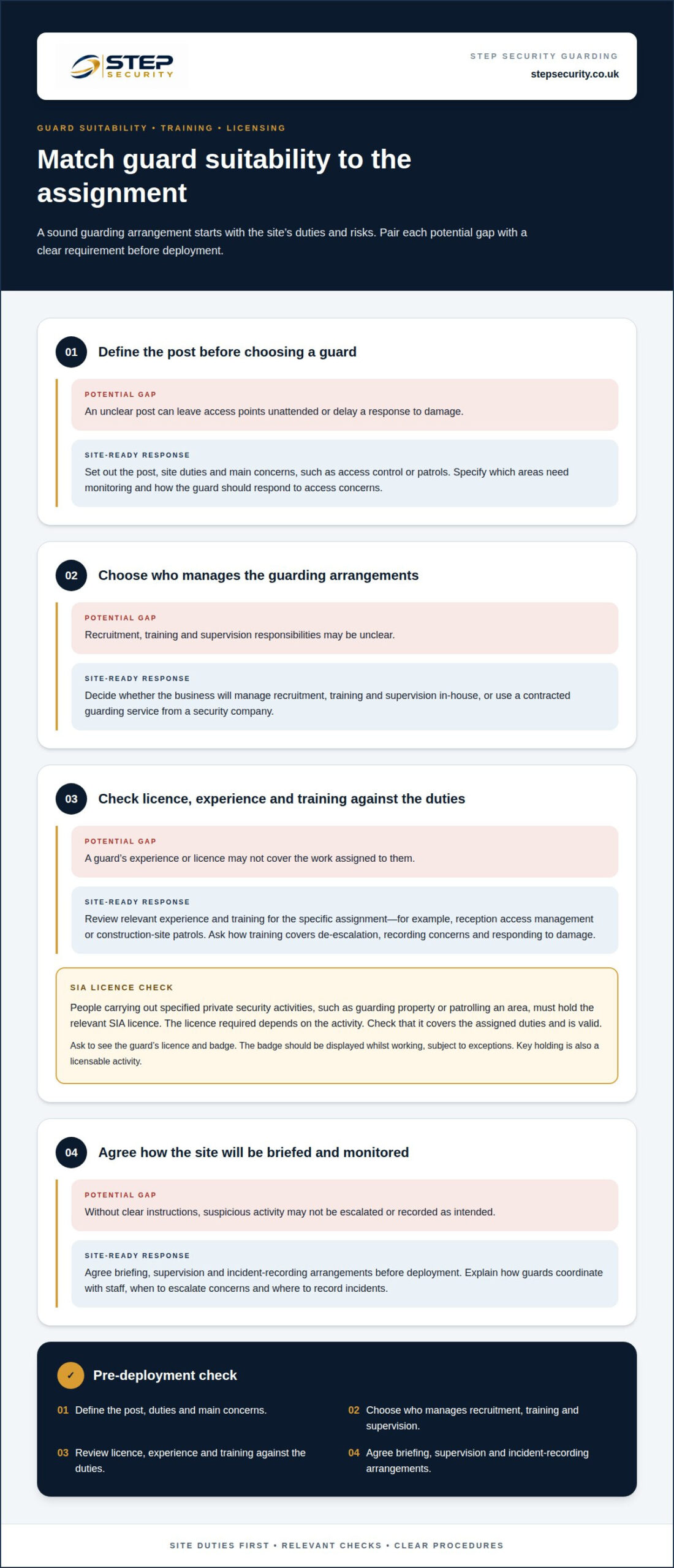
Set your requirements before hiring and follow a clear sequence:
- Define the post, site duties and main concerns, such as access control or patrols.
- Choose who will manage recruitment, training and supervision.
- Review each guard’s relevant licence, experience and training against the duties.
- Agree briefing, supervision and incident-recording arrangements before deployment.
What is an on-premises security guard?
An on-site guard works at a business location, monitoring buildings, entrances, car parks or storage areas. They identify unusual activity and respond according to site procedures.
UK rules apply to specified security activities. People guarding property or patrolling an area must hold a relevant SIA licence under the Private Security Industry Act 2001, according to The National Archives. A guard isn’t legally required at every premises; exposure, operations and risks shape the decision.
Begin a business security risk assessment by mapping the property and its daily routines. Note valuable assets, public entrances, delivery areas, isolated spaces and times when staffing changes. At a construction site, consider open boundaries, equipment storage and vehicle access. Review previous incidents and suspicious activity to identify recurring vulnerabilities.
Next, match each risk to a practical control. A busy reception may need access monitoring, while a large commercial site may need patrols through less visible areas. Guards can monitor entrances and storage spaces, respond to concerns and record incidents. CCTV footage can support their observations, but it does not replace a person assessing events and following site procedures.
There is no universal number of guards for business premises. The deployment depends on the area to cover, access points, operating hours, risk level and whether one post or several locations need continuous attention.
Hiring guards also means defining responsibilities clearly. Set out who briefs them, which areas they monitor, how they escalate suspicious activity and where they record incidents. Unclear instructions can leave access points unattended or delay a response to damage. Before deployment, explain how guards coordinate with staff and emergency procedures.
For site-specific coverage, consider how commercial site security from Step Security Guarding can align guard duties with access points, operating routines and identified risks.
Professional security companies can assess potential vulnerabilities and put measures in place to address them before incidents occur. Businesses can use security guards to monitor CCTV footage on site.
Construction site theft, trespassing and asset protection
Construction sites combine valuable equipment, changing layouts and multiple access points. On-site guarding can help control entry and respond to concerns.
Theft and Trespassing on Construction Sites
On-site guards monitor access points and patrol areas where equipment, materials or vehicles are stored. Their presence can deter trespassing and help identify suspicious activity before it escalates. At a site with several entrances, agreed patrol routes and clear reporting procedures help officers spot unauthorised access and raise concerns promptly. Visitor, worker and vehicle logbooks also provide a record of site activity.
Protecting Site Assets
Asset protection involves monitoring equipment, materials and vulnerable areas to reduce opportunities for theft or damage. Guards can check storage locations, note unusual movement and report concerns through site procedures. Patrols can take place at scheduled intervals or varying times, helping officers identify damage, unauthorised access or safety concerns. CCTV can support observations, but it does not replace a guard’s assessment and response.
On-site Guarding
At a business premises, an on-site guard provides a consistent presence at a defined post or across agreed areas. Duties may include monitoring entrances, managing visitors and responding to alarms alongside site staff. Key holding can also support alarm response when a business needs an officer to attend. At a construction site, instructions should reflect changing access arrangements, active work areas and the locations of stored assets.
Visual Deterrence
A visible guard can deter criminal activity by showing that entrances and site areas are monitored. This is one layer of security, not a guarantee against incidents. Businesses can combine guarding with CCTV, alarms, access control, fencing and lighting. For example, a guard can investigate an alert, assess the situation and follow site procedures, while cameras provide supporting footage. Used together, these measures strengthen oversight without treating technology as a substitute for on-site judgement.
What types of security guards can businesses hire in the UK?
The right type of guard depends on the location, access arrangements and required duties. A fixed reception post calls for a different deployment from patrols across a large site or crowd supervision at an event.
Static guards are assigned to a defined post, such as a reception desk, gate or loading entrance. They monitor that point and manage access according to site procedures. Mobile patrols move between premises or areas, checking for damage, suspicious activity and signs of security breaches. Patrols may suit businesses that need regular checks rather than a fixed post.
In an office, a corporate security officer can monitor building access and help manage staff, suppliers and visitors. Concierge security combines front-of-house duties with security awareness at the entrance. In a warehouse, access control can restrict entry to employees while helping monitor visitors. Retail security officers can monitor entrances, security cameras and stock areas.
Construction security guards can focus on site access, patrols and protecting equipment and materials. At events, security personnel manage entry points, crowd movement and potential threats. These roles need clear instructions tailored to the venue, event or site’s operating procedures.
Key holding and alarm response is another option. A professional key holder can respond to alarms or incidents when the owner is away or unable to attend. This differs from having a guard stationed on site, so consider whether the need is a regular presence, mobile checks or a response to an alert. Match the role to the site’s access points, visitors and daily operations.
Discuss a suitable security guard service for your business premises, event or construction site.
Some assignments focus on entry checks as well as general monitoring. Security guards can control access by checking the ages of people entering a nightclub, searching and vetting event attendees, or restricting employee access while monitoring visitors. These examples show how a guard’s duties can reflect who needs to enter a particular site.
At financial institutions, security guards may escort cash during transport. Hotel security guards can manage queues and crowds during busy periods or events. These examples show why a deployment may need to suit a particular setting, whether it involves a fixed post, patrol or response service.
Step Security Guarding: Security Guard Service
Step Security Guarding provides security guard services for businesses that need organised on-site protection. Its manned guarding can support premises where a visible officer, access oversight or regular patrols fit operational requirements.
For building and construction projects, Building Site Security Guards and Construction Security Guards can monitor entrances, visitors and site activity. Clear post instructions align guard duties with the premises, access points and identified concerns. This service suits businesses that need a dedicated presence and construction sites requiring focused oversight of equipment and entry arrangements.
Share the site’s requirements and the security concerns you need addressed. Contact Step Security Guarding to discuss a suitable guarding arrangement.
Plan protection around changing site needs
Security arrangements work best when they reflect how a business operates. Changes to access arrangements, site layout or visitor activity can shift where attention is needed. Make guarding part of operational planning, with clear responsibilities and communication between officers and site teams.
Step Security Guarding provides Manned Guarding for commercial premises, alongside Building Site Security Guards and Construction Security Guards for projects requiring site-focused protection. The right service depends on the environment and required duties. If you are considering security guards for business premises, discuss your location, operating requirements and main concerns with Step Security Guarding.
Set out what effective coverage needs to support, then make a considered plan for the site. Discuss your requirements with Step Security Guarding and move forward with a practical guarding arrangement.
Frequently Asked Questions
What duties can security guards legally perform on business premises in the UK?
Guards may monitor, manage access, patrol and report incidents within site procedures. Guarding property against damage, theft, unauthorised access or disorderly behaviour is licensable; specified private security activities require a relevant SIA licence under the Private Security Industry Act 2001, according to The National Archives. A citizen’s arrest may be made under the Police and Criminal Evidence Act 1984, according to The National Archives, where legal conditions apply; only reasonable force may be used.
What SIA licence does a security guard need in the UK?
The guard needs a valid SIA licence covering the specific activity they perform, such as guarding property or patrolling an area. The Security Industry Authority says key holding, including keeping or controlling access to a key or a device that operates locks, is a licensable security activity.
What risks and liabilities should businesses consider when hiring security guards?
Businesses should check that each guard’s SIA licence is valid for the assigned duties. Hiring someone for security work without a valid licence could result in a fine or imprisonment. Define duties and escalation procedures clearly to reduce the risk of unattended access points or delayed responses to incidents.